
Lawptimize Admin
Why Litigation Strategy Needs Probabilistic Intelligence
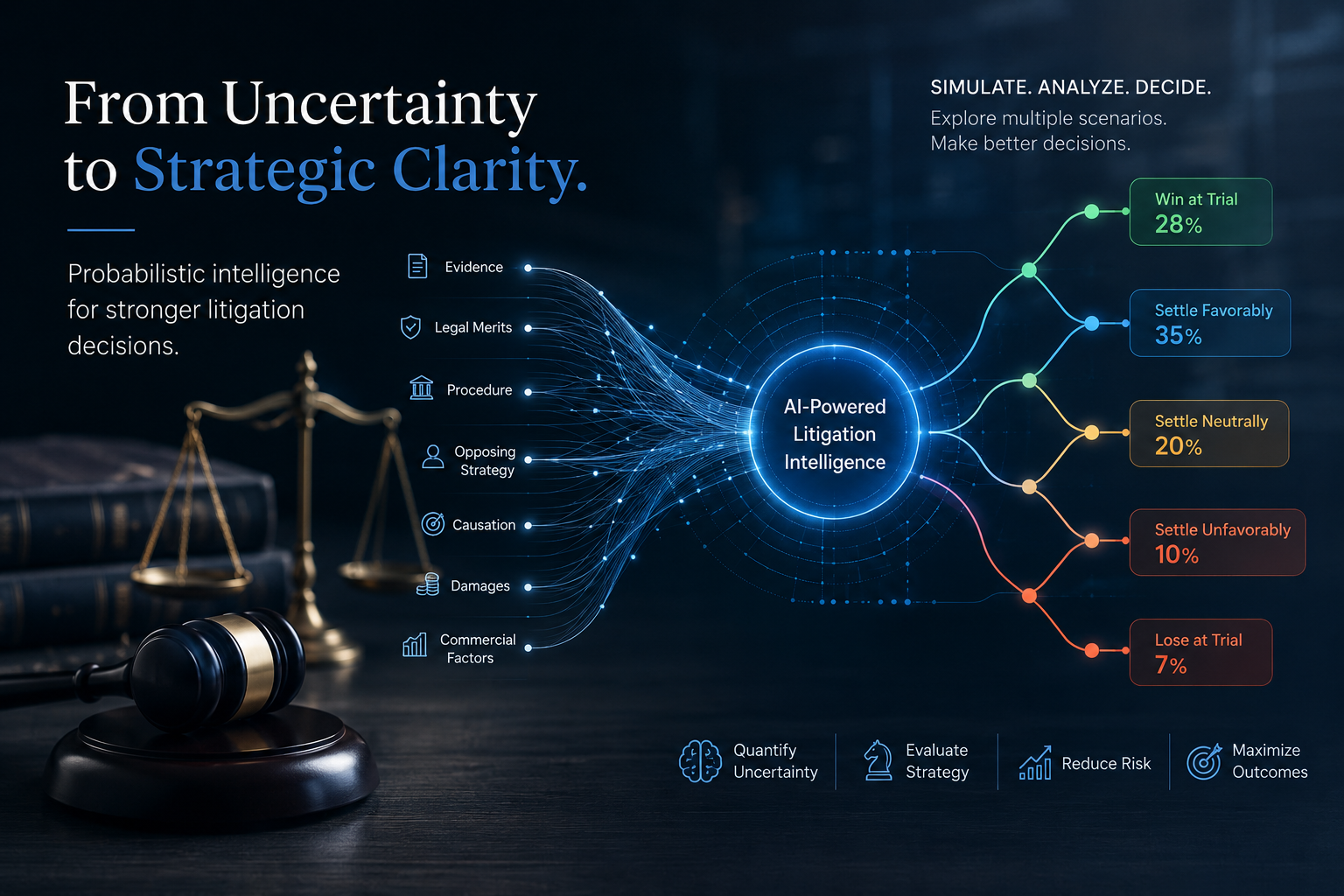
Litigation has always involved uncertainty. Even the most experienced legal professionals routinely make high-stakes decisions based on incomplete information, evolving evidence, shifting judicial attitudes, procedural developments, and human behaviour that cannot be predicted with absolute certainty. Yet despite the complexity and financial significance of modern disputes, litigation strategy is still largely driven by intuition, fragmented assessment, and subjective judgment rather than structured analytical modeling.
For decades, the legal profession has relied on experience as the primary mechanism for evaluating litigation risk. Experience remains invaluable, but experience alone is increasingly insufficient in a world where disputes are becoming more complex, data-rich, and financially consequential. Legal teams are now expected not only to argue effectively, but also to quantify exposure, justify strategic decisions, assess settlement pathways, and communicate risk clearly to clients, insurers, funders, and stakeholders.
This is where probabilistic intelligence becomes essential.
Probabilistic intelligence does not attempt to eliminate legal judgment. Nor does it seek to replace lawyers with artificial intelligence. Instead, it introduces structure, consistency, and strategic clarity into decision-making processes that have historically depended heavily on instinct. By modeling uncertainty, evaluating multiple litigation pathways, and analyzing strategic variables simultaneously, probabilistic systems allow legal professionals to approach disputes with greater analytical rigor and more informed strategic awareness.
The future of litigation strategy will not belong to lawyers who simply possess more information. Information is already abundant. The competitive advantage will belong to legal professionals who can interpret uncertainty more effectively, evaluate probabilities more consistently, and make higher-quality strategic decisions under pressure.
Traditional legal analytics platforms have primarily focused on retrospective analysis: judgments, precedents, legal databases, and document review. While these tools provide value, they often fail to address the central challenge facing litigators in real-world disputes: how to navigate uncertainty dynamically as litigation evolves.
Modern litigation requires a more adaptive form of intelligence. Strategic decision-making in disputes involves evaluating not only legal merits, but also negotiation dynamics, procedural risk, timing pressures, opposing party behaviour, evidentiary volatility, cost exposure, and commercial considerations. These variables interact continuously throughout the life cycle of a dispute, creating an environment that is far more complex than static legal analysis alone can capture.
AI-assisted litigation intelligence introduces a different approach. Rather than merely retrieving legal information, advanced decision-support systems can help legal professionals structure assessments, model strategic scenarios, simulate potential pathways, and identify hidden patterns in litigation reasoning. By combining probabilistic analysis with adaptive algorithms and strategic simulations, litigation intelligence platforms can assist lawyers in making decisions that are not only legally sound, but strategically optimized.
Importantly, this does not diminish the role of human expertise. On the contrary, the most effective litigation intelligence systems are designed to augment professional judgment rather than automate it. Experienced litigators possess contextual understanding, advocacy skill, negotiation instinct, and strategic nuance that cannot be replicated by software alone. The role of intelligent systems is to enhance those capabilities by reducing cognitive blind spots, increasing consistency, and helping teams navigate uncertainty more systematically.
This shift mirrors transformations that have already occurred in other high-stakes industries. Financial institutions, insurers, logistics companies, and investment firms have long embraced probabilistic modeling and decision intelligence to improve strategic outcomes under uncertainty. Litigation is now beginning to undergo a similar evolution.
As artificial intelligence continues to mature, the legal industry faces an important distinction. The future of legal AI is not simply about automating documents or generating text. The deeper transformation lies in the emergence of intelligent systems capable of supporting strategic legal reasoning itself.
The firms that embrace this evolution early will gain a meaningful advantage. They will be better equipped to assess risk, evaluate settlement opportunities, allocate resources, communicate uncertainty, and make more informed litigation decisions. In increasingly competitive and high-value disputes, that strategic advantage may prove decisive.
The future of litigation strategy will belong not only to those who understand the law, but to those who can understand uncertainty itself.
About the author
View the algorithms of Lawptimize applied in litigation. Book a demo with us.
Data Driven Litigation for Legal professionals and clients.
London / Singapore / San Francisco
Email. lawptimize@lawptimize.com