
Lawptimize Admin
Ronald Dworkin, Legal Judgment, and Why AI Will Never Replace the Lawyer
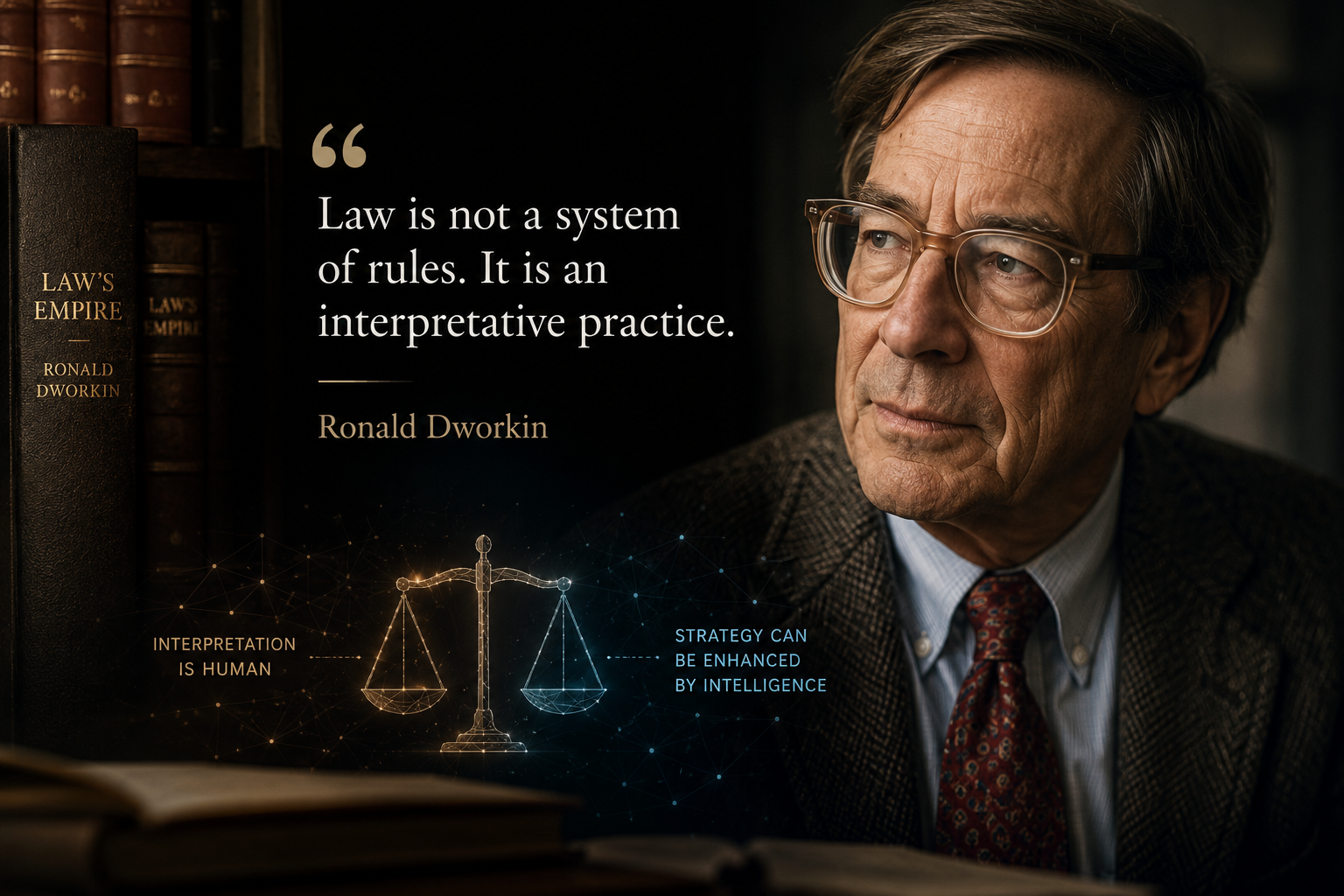
The rapid adoption of artificial intelligence within the legal profession has inevitably raised a familiar question: can machines eventually replace legal reasoning?
Most discussions focus on capability. Can an AI draft a contract? Can it summarise authorities? Can it identify relevant precedents more quickly than a junior lawyer? These are important questions, but they overlook a more fundamental issue. They assume that legal reasoning is primarily a process of retrieving and applying rules.
Ronald Dworkin challenged precisely that assumption.
In Law’s Empire, Dworkin argued that law is not simply a system of rules waiting to be mechanically applied. Legal reasoning requires interpretation. Judges do not merely identify legal rules; they seek the interpretation that best fits the existing body of law while providing the strongest moral and institutional justification for the legal system as a whole. Law, therefore, is not a purely deductive exercise. It is an interpretative one.
This distinction has important implications for artificial intelligence.
Modern Large Language Models are exceptionally good at processing information. They can retrieve authorities, identify patterns across thousands of cases, summarise complex judgments, and generate persuasive legal arguments. These capabilities are transforming legal practice and will continue to do so.
However, generating an argument is not the same as exercising legal judgment.
In litigation, two experienced lawyers frequently reach different conclusions despite relying upon the same authorities, the same evidence, and the same procedural framework. Their disagreement rarely arises because one has failed to identify the relevant law. Instead, it reflects differing interpretations of risk, credibility, judicial behaviour, commercial objectives, and litigation strategy.
These are not failures of legal knowledge. They are exercises in judgment.
Dworkin’s theory reminds us that legal reasoning is inseparable from interpretation. It requires weighing competing principles, evaluating alternative narratives, and selecting the interpretation that best explains the dispute within its broader legal context. These decisions cannot be reduced to a single algorithm or a definitive answer generated from a database.
This does not diminish the value of artificial intelligence. Quite the opposite.
The greatest opportunity for AI may not lie in replacing legal interpretation but in supporting the strategic decisions that surround it. Once competing legal interpretations have been identified, lawyers must still decide how to proceed. Should a claim be advanced? Should settlement be pursued? Should additional evidence be obtained? Should resources be invested in one legal argument rather than another?
These questions are not primarily interpretative. They are strategic.
This is where intelligent decision-support systems can make a meaningful contribution. By modelling uncertainty, evaluating alternative litigation pathways, and helping legal professionals understand the consequences of different strategic choices, AI becomes an enhancement to legal judgment rather than a substitute for it.
Perhaps this is where the future of legal technology truly lies.
Dworkin taught us that law is an interpretative practice grounded in human judgment. Artificial intelligence does not undermine that insight. Instead, it encourages us to distinguish more carefully between interpretation and strategy. The former remains fundamentally human. The latter can increasingly be informed by intelligent analytical systems.
The future of litigation will not be shaped by choosing between lawyers and AI.
It will be shaped by combining the strengths of both.
About the author
View the algorithms of Lawptimize applied in litigation. Book a demo with us.
Data Driven Litigation for Legal professionals and clients.
London / Singapore / San Francisco
Email. lawptimize@lawptimize.com