
Lawptimize Admin
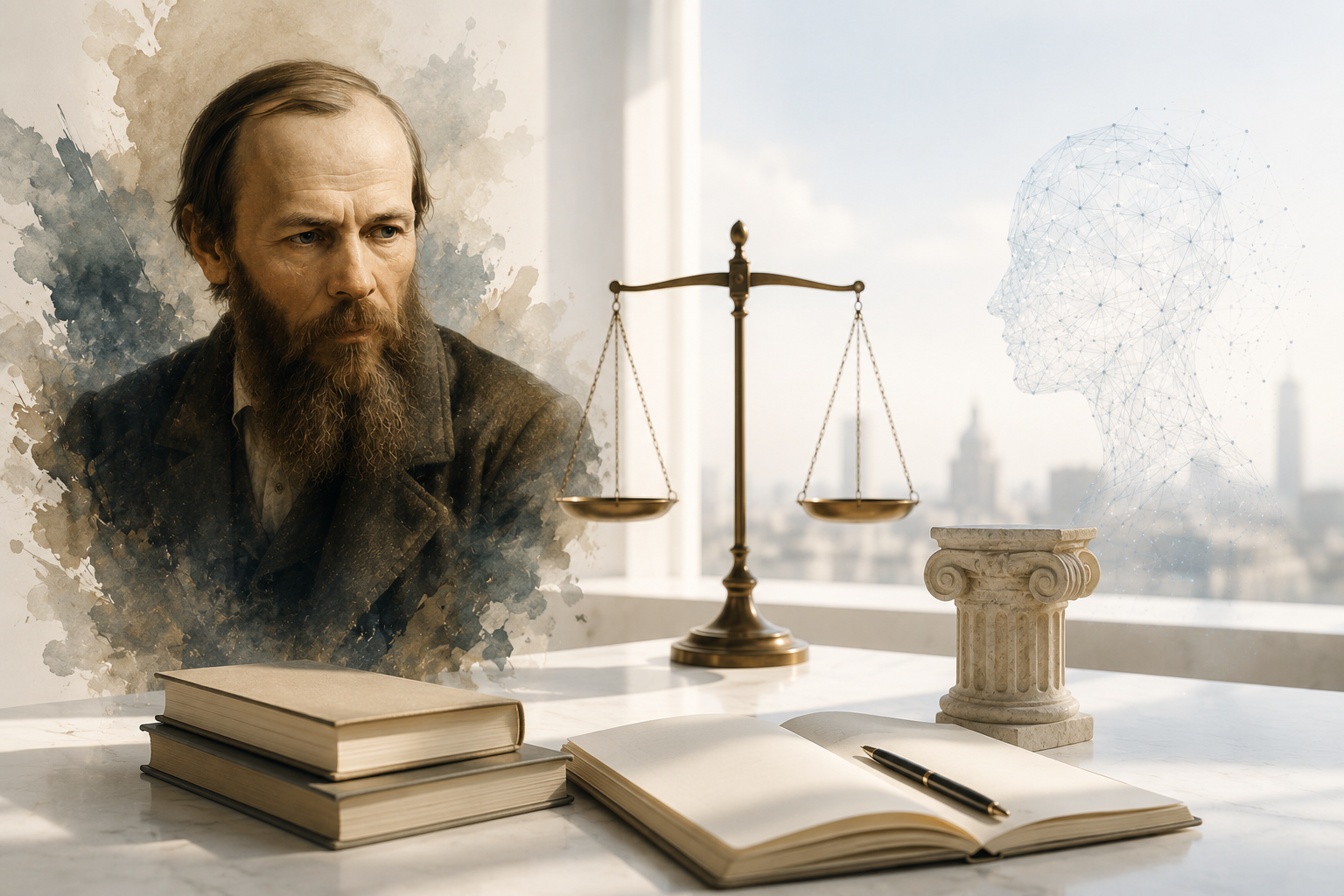
Dostoyevsky, Justice, and Why the Law Can Never Be Reduced to Algorithms
The rapid development of artificial intelligence has encouraged many to ask whether legal reasoning can eventually become a computational exercise. If legislation, case law, procedural rules, and judicial decisions can all be digitised, perhaps legal disputes become little more than problems waiting to be solved by increasingly sophisticated machines.
It is an attractive idea.
Yet it assumes that justice is simply the correct application of legal rules.
Fyodor Dostoyevsky would almost certainly have disagreed.
Throughout works such as Crime and Punishment, The Brothers Karamazov, and The Idiot, Dostoyevsky explored a recurring theme: human beings cannot be fully understood through rules alone. Law may determine guilt, but justice requires something deeper. Motive, conscience, remorse, compassion, irrationality, and redemption all shape the moral landscape in ways that no legal code can completely capture.
His novels repeatedly remind us that legal certainty and moral certainty are not always the same thing.
This distinction remains remarkably relevant today.
Modern artificial intelligence excels at processing information. It can analyse thousands of judgments, identify legal authorities within seconds, summarise complex evidence, and construct coherent legal arguments. These capabilities are transforming legal practice and will continue to do so.
But none of these tasks require an understanding of the human condition.
Litigation is rarely confined to legal doctrine. Every dispute involves people acting under pressure, incomplete information, emotion, commercial interests, and strategic uncertainty. Two clients facing identical legal circumstances may require entirely different advice because their objectives, appetite for risk, or willingness to settle differ fundamentally.
The law provides the framework.
Judgment determines how that framework should be applied.
This is where the future of legal AI may ultimately be defined. The objective should not be to replace legal judgment with algorithms, but to strengthen the lawyer’s ability to navigate complexity. Artificial intelligence can organise information, model alternative scenarios, and reveal patterns that would otherwise remain hidden. It can become an extraordinarily powerful analytical partner.
It cannot decide what justice requires.
That responsibility remains with the legal professional.
Perhaps this is Dostoyevsky’s enduring lesson for the age of artificial intelligence. Justice has always involved more than the mechanical application of rules. It requires an understanding of people, motives, consequences, and moral complexity.
As legal technology continues to evolve, we should embrace its extraordinary capabilities while remembering that the purpose of law is not simply to reach an answer.
It is to reach the right answer for human beings.
Technology may help us reason more effectively.
Justice, however, remains profoundly human.
About the author
View the algorithms of Lawptimize applied in litigation. Book a demo with us.
Data Driven Litigation for Legal professionals and clients.
London / Singapore / San Francisco
Email. lawptimize@lawptimize.com